Suites & steps
A suite is the durable artifact WeftKit produces from a recording: an ordered list of semantic steps, each with the locators, waits, and assertions needed to reproduce it. You edit intent here — never implementation code.
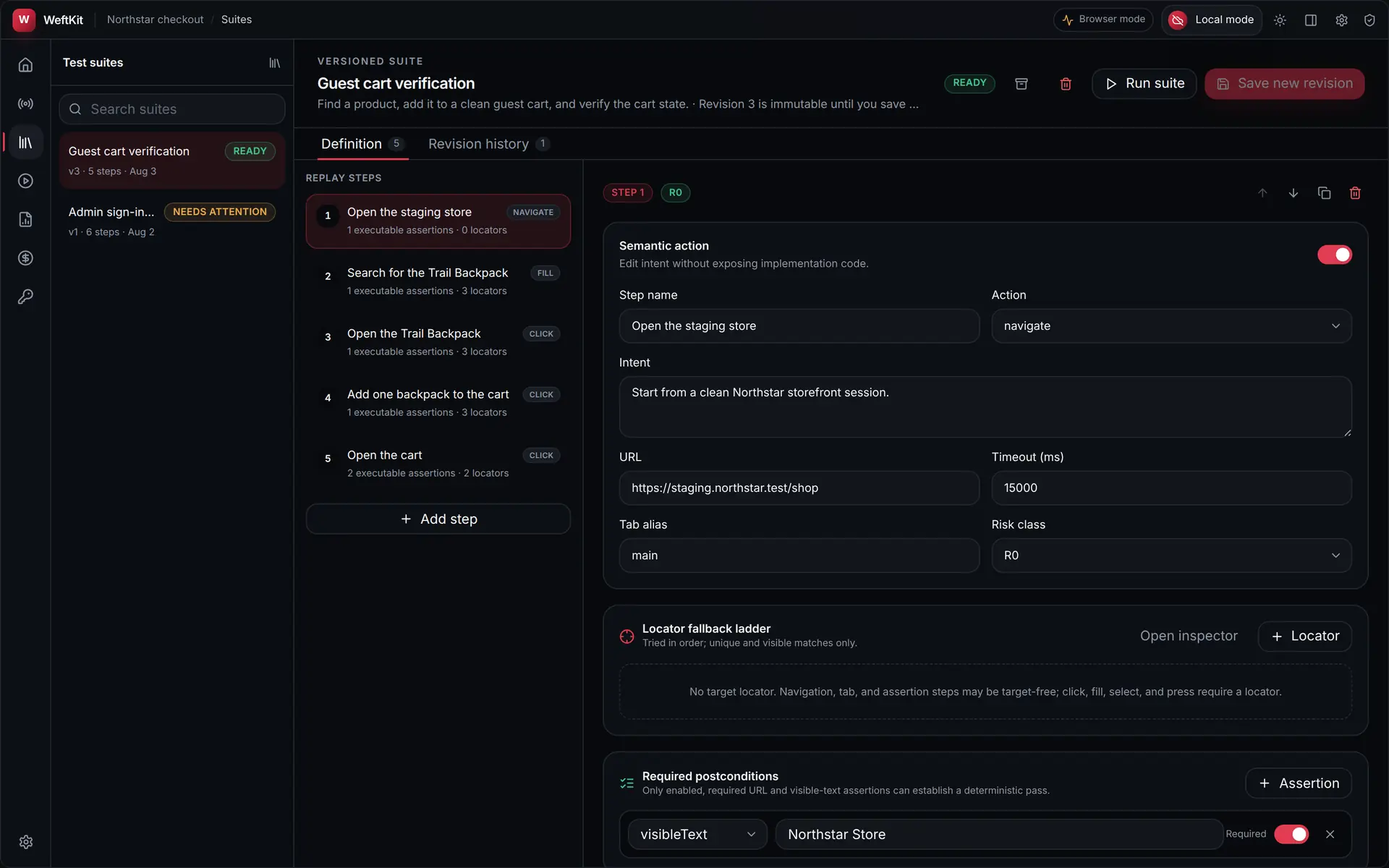
What a step contains
| Field | Meaning |
|---|---|
| Step name & intent | The human description of what this step accomplishes, kept separate from how it is performed. |
| Action | navigate, click, fill, select, press, tab, or assert. |
| Locator fallback ladder | Ordered strategies for finding the target element. Replay walks the ladder before it gives up. |
| Timeout | An explicit wait budget, in milliseconds. |
| Tab alias | Names the tab a step acts on, so multi-tab flows replay against the right window. |
| Risk class | R0 to R4 — how consequential this action is if it executes for real. |
Risk classes
Every step carries a risk class, and that class drives the policy applied at replay. Read-only navigation and inspection sit at the bottom of the scale; payments, irreversible deletion, publication, and outbound messages sit at the top and require explicit handling rather than silent execution.
Executable assertions
Steps are counted by their executable assertions — the checks replay will actually evaluate — so the editor never inflates coverage with decorative expectations. An assertion recorded into a revision cannot be weakened afterwards: an AI repair proposal has to validate against the immutable revision, not replace it.
Revisions are immutable
A suite revision is frozen once saved. Editing produces a new revision rather than mutating the one your past runs were executed against, which is what makes an old report still mean something. The editor shows the current revision, and the revision history tab records how the suite got here.
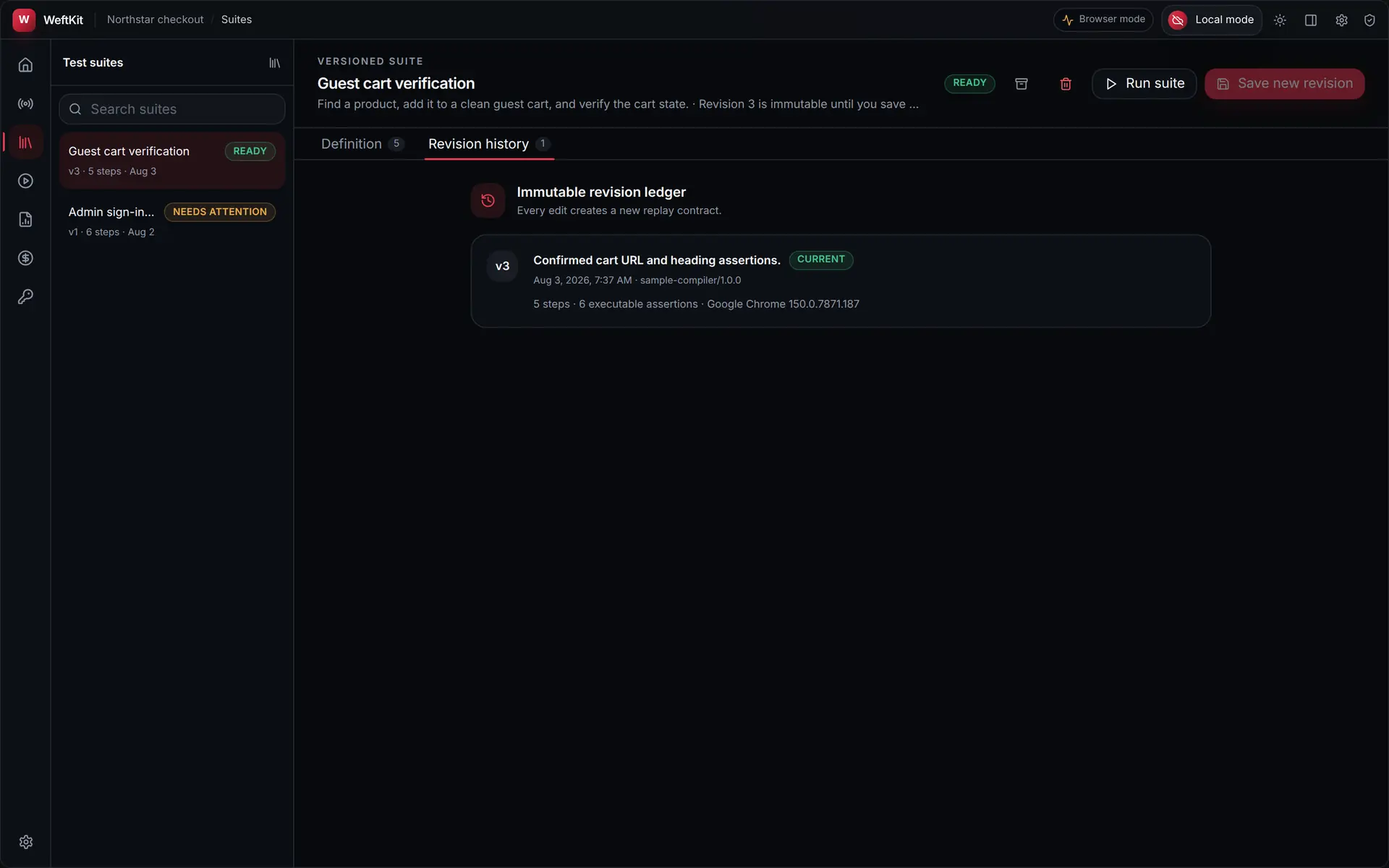
Suite status
- Ready — the suite has executable assertions and every prerequisite is configured, so it can be replayed.
- Needs attention — something blocks a faithful replay, most commonly a secret reference that has no value configured yet in the vault.